 Apricus.
Compliance management simplified
For compliance officers, risk teams, and business unit owners who need one place to track obligations — from identification through evidence, approval, and audit-ready reporting.
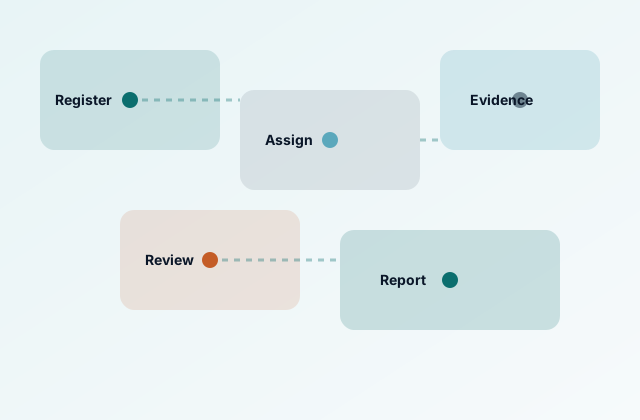
Compliance work scatters across people and files
Regulatory and internal obligations rarely live in one clean system. Teams often juggle spreadsheets, email threads, shared folders, and calendar reminders. Owners change. Due dates slip. Evidence is hard to find when an auditor asks for proof. Leadership struggles to answer a simple question: what is open, what is overdue, and who is responsible?
That fragmentation creates operational risk. Exceptions are handled inconsistently. Escalations happen late. Reports take days to assemble. The effort falls on a few specialists who become the bottleneck for every status update.
One register. Clear ownership. Traceable completion.
The Compliance Tracking System is a centralized platform to identify, assign, monitor, track, and report compliance obligations. It is designed as a working system of record — not a static checklist — so status, evidence, and accountability stay connected as work moves.
Teams define obligations once, assign owners, set timelines, complete work with supporting evidence, run review and approval, close items cleanly, and produce management visibility without rebuilding a report from scratch every cycle.
Compliance register
Maintain a structured register of regulatory and internal obligations so teams share one source of truth instead of competing spreadsheets.
Calendar & due dates
See what is upcoming, due, or overdue and plan work against the period that matters for your control calendar.
Assignment
Allocate responsibility to owners and teams so completion is never an anonymous shared task with no clear owner.
Evidence management
Attach supporting proof for reviews and audits, keeping evidence linked to the obligation it supports.
Exceptions & escalation
Handle exceptions deliberately and escalate risks early when work stalls, status degrades, or timelines are at risk.
Dashboards & audit trail
Give management operational visibility and preserve an activity history for accountability and review.
From obligation to closure
The workflow mirrors how compliance work actually gets done: define the obligation, put a responsible person in charge, complete the control activity, capture proof, review the outcome, and leave a trail leadership can inspect later.
- Obligation management
- Notifications
- Document management
- Risk monitoring
- Approval workflow
- Management reporting
Notifications and escalations reduce the need for manual chasing. Reporting is built on the same operational data that teams use day to day, so leadership views stay aligned with frontline reality.
Roles that gain control
Compliance leaders
See portfolio status, overdue work, and exception patterns without assembling updates by hand every week.
Control owners
Know exactly what is assigned, when it is due, and what evidence is expected for completion.
Risk & audit stakeholders
Review history, evidence linkage, and process consistency when questions arise.
Business unit teams
Execute obligations inside a guided workflow instead of ad-hoc email instructions.
Designed to help with
- Recurring obligation tracking
- Ownership and due-date discipline
- Evidence collection for reviews
- Escalation of stalled or high-risk items
- Management and audit-facing reporting
What a demo will clarify
- How obligations are modelled for your controls
- How evidence and approvals fit your process
- Which roles receive notifications and escalations
- How reports map to management reviews
Common questions
What is the Compliance Tracking System?
A centralized platform to identify, assign, monitor, track, and report compliance obligations with evidence and audit trail support.
Can compliance be assigned to owners?
Yes. Obligations can be assigned so responsibility is explicit and progress is measurable.
Can evidence documents be uploaded?
Yes. Evidence management keeps supporting materials linked to the obligation they substantiate.
Are notifications and dashboards supported?
Yes. Notifications support operational follow-up, and dashboards provide management visibility into status and risk signals.
Explore the compliance platform
Request a guided walkthrough using your control calendar and reporting needs as context.
Request a demo